

How To Set Up Personal Cloud Server
How can I create a personal cloud server?
Updated: 12/31/2020 by Reckoner Hope
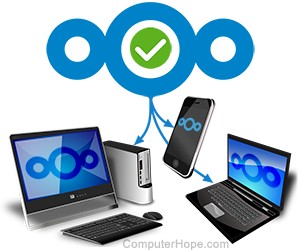
Cloud computing services have become widely used, ranging from deject storage services, like Dropbox and iCloud, to productivity suites, similar Google Workspace and Office 365. These services offer the ability to sync documents across devices and to use professional software from any spider web browser or mobile device. Every bit deject computing matures, an increasingly pop solution is for users to operate a personal deject server.
In these instructions, we create a deject storage service yous control using the open-source software, Nextcloud. Nosotros create a local test server, limited to operating in your local network. Then we install the Nextcloud client on your desktop computer and mobile device, and synchronize files between them. Then we show how you tin can run this aforementioned general configuration on a remote hosting service, so you can admission your cloud from anywhere.
About Nextcloud
Nextcloud is a deject storage server designed to scale to hundreds of thousands of users. Yous tin can run the client software on Windows, macOS, Linux, Android, and iOS, syncing files to multiple devices.
You can besides access your files on the web by logging in to your Nextcloud spider web portal. The portal features an Ambassador Control Panel, where you can add users, configure group permissions, and set individual disk quotas. The portal too uses a plugin system to provide additional features, such as real-time chat and video conferencing for yous and your other users.
To learn more nearly Nextcloud, visit the official website at https://nextcloud.com.
Creating a local Nextcloud server
Note
If you desire to skip the local installation and install Nextcloud on a web hosting service with a domain name, proceed to running Nextcloud on the Internet.
In this department, we create a Nextcloud server on your local network. The cloud service is only available to devices connected to your network. This setup lets you lot endeavour out Nextcloud in the security of your local network, without spending any coin on a domain name or a remote web hosting service.
Y'all could run the server on a defended computer, simply for testing, it's easier to install information technology on a VM (virtual auto), which you can run on your main computer. Your computer requires the following resources:
- A 64-bit CPU with a 64-bit operating organization. If you lot're not sure, see: How to determine if you have a 32-bit or 64-bit CPU.
- An Internet connection.
- x GB of gratis deejay space.
- At least 1 GB of RAM to dedicate to the VM.
Download Ubuntu 18 Server
Nextcloud requires a server running Linux. The recommended Linux OS for Nextcloud is Ubuntu Server, so that'southward what nosotros use in this instance.
Ubuntu is costless to download and use. Download Ubuntu Server 18.04 from http://releases.ubuntu.com/18.04.two/ubuntu-xviii.04.2-alive-server-amd64.iso. It'southward a large file, at about 2 GB.
Install VirtualBox and create a VM
In this example, we use Oracle VM VirtualBox to create and run our VM. VirtualBox is free of charge for personal use.
- In a browser, become to https://www.virtualbox.org/wiki/Downloads. Click Windows hosts to download the installer for Windows.
- Run the installer using the default installation options. When the installation is complete, run VirtualBox.
- In VirtualBox, click New to create a new virtual motorcar.

- Name the VM. The proper name can be anything, only information technology should incorporate the word Ubuntu. Make certain "Blazon" is set to Linux and "Version" is set to Ubuntu (64-bit). Click Side by side.

- Set the "Retentiveness size" to 1024 MB (1 GB). Click Adjacent.

- For "Hard disk," choose Create a virtual hard disk drive at present and then click Create.

- For "Difficult disk file type," cull VDI. Click Next.

- For "Storage on physical hard disk drive," choose Dynamically allocated.

- For "File location and size," choose a deejay size of x GB. (You can cull a larger size if y'all'd like.) Click Create.

- Configure the network adapter, and then information technology'south role of your local network. With your VM highlighted on the left, click Settings.

- On the left, click Network. On the right, under "Attached to," select Bridged adapter. Click OK.

- The VM is set to go. Click Start.

- At "Select start-up deejay," click the folder icon, and choose the Ubuntu ISO you downloaded. If information technology'south still downloading, wait until the download is complete. Click Showtime.

The Ubuntu Server ISO boots. Your virtual machine is up and running.
Install Ubuntu Server on your VM
Your VM boots into the Ubuntu Server live ISO, which contains the Ubuntu installer.
Note
When you click inside the VM window, it captures your mouse and keyboard. Your mouse cursor will disappear, and you may not exist able to utilize Windows shortcuts such as Alt+Tab. You can release the keyboard and mouse by pressing the VirtualBox "Host Cardinal," which is the correct Ctrl key on your keyboard. To proceed using the VM, click within its window once more.
Note
The installer interface is text-just. In the following steps, utilize the upwards, down, and Tab keys to change the highlighted option, the spacebar to toggle a check box, and Enter to make a selection.
- Set your keyboard type. If you're using a standard The states keyboard, press Enter.
- Choose Install Ubuntu and press Enter.

- Under "Network connections," choose the network adapter that Ubuntu should employ. In this example, we want it to apply our Ethernet connection (eth). Choose Done and printing Enter.

- At "Configure proxy," press Enter.
- At "Configure Ubuntu archive mirror," printing Enter.
- Under "Filesystem setup," choose the default, Use an Entire Deejay. Press Enter.

- The 10 GB VirtualBox VDI is the only disk. At "Choose the disk to install to," press Enter.

- Review the summarized information, and then choose Done and press Enter.
- Under "Confirm destructive action," cull Keep and press Enter.

- Under "Profile setup," create a new user profile. The new profile is besides the default Ubuntu administrator account. "Your name" tin be anything you like. For "Your server'south name," enter a hostname for your computer (using simply numbers, lowercase messages, dashes, and underscores), such as nextcloud. For "username," cull the name you want to use to log in to the computer (using lowercase letters and no spaces). Cull a countersign, and enter it again to verify. Choose Washed and press Enter.

- Under "SSH setup," select the box marked Install OpenSSH server. An SSH allows you lot to remotely connect to the machine if necessary. Choose Washed and press Enter.

- Under "Featured Server Snaps," choose Nextcloud. Cull Washed and printing Enter.

- The installation process continues. When information technology'due south washed, choose Reboot at present to kick the installed operating organization.

Configure Ubuntu and install Nextcloud server
- When the server boots, log in with the proper noun and password you chose during Ubuntu profile setup.
Note
You might notice that the login prompt gets mixed up with other arrangement letters. If you don't see the login prompt, press Enter to display a new one.

- Perform an initial system update. Run sudo apt-go update && sudo apt-get upgrade && sudo apt-get dist-upgrade. Enter your password when prompted. If y'all're asked to confirm an upgrade, type y, and press Enter.

- Add a firewall rule to allow OpenSSH connections. Run sudo ufw allow OpenSSH.
- Run sudo ufw enable to enable the firewall.
- Run sudo ufw status to verify that the firewall is filtering the server'due south network traffic.

- Start the Nextcloud installer. Run sudo nextcloud.manual-install user pass . For user and pass, cull the proper noun and countersign yous want to use with your Nextcloud account. Information technology can be different than your Ubuntu name and password. This account is the Nextcloud administrator business relationship.

Afterward a few moments, you lot meet:
Nextcloud was successfully installed
- Adjacent, open ports 80 (HTTP) and 443 (HTTPS) in your firewall. Run sudo ufw allow eighty,443/tcp.

- Nextcloud maintains an internal list of trusted domains. Only requests addressed to these domains get a response from the Nextcloud server. Past default, the but trusted domain is localhost (the server can merely respond to itself). To view the trusted domains, run sudo nextcloud.occ config:system:become trusted_domains.

- You demand to add together your server's IP address to the trusted domain list. Starting time, determine your server'due south IP address. Run ip a | grep inet to discover the IP address of the server on your local network. If yous are on an IPv4 network, it should outset with 192.168 or 10.0.

- Here, our address is 192.168.1.173. At present, set this address as a trusted domain. Run sudo nextcloud.occ config:arrangement:gear up trusted_domains 1 --value=domain , where the domain is the IP accost of your server.

- Create an SSL document so that Nextcloud can encrypt your data over HTTPS. Because this deject is restricted to your home network, you tin utilize a self-signed certificate. Run sudo nextcloud.enable-https cocky-signed.

Server configuration is consummate, and your cloud is operational. The Nextcloud service is running, and your server is listening on your local network for HTTP and HTTPS connexion requests.
Log in to Nextcloud
To log in to your Nextcloud web dashboard, you need to add a security exception to your browser, so it accepts your self-signed SSL certificate. Normally, yous would never want to create an exception like this, unless y'all control the server and network. (This pace is not required if you lot're running Nextcloud on the Net, in which case it uses Let's Encrypt to provide SSL certificates.)
- In a browser, go to the address of your Nextcloud server. In this example, the address is 192.168.ane.173.
- Your web browser volition warn you that the SSL certificate is cocky-signed. In Chrome, click Advanced, and so Proceed to.

If you're using Firefox, click Advanced, Add Exception, Confirm Security Exception.

- Enter your Nextcloud username and countersign, as you configured them when installing Nextcloud. Click Log in.

- In the Nextcloud dashboard, you can view and work with the files you've stored in the cloud. If you click the gear icon (⚙), you tin can access Administrator settings and customize your server preferences. No configuration is necessary to begin using Nextcloud, then we won't change anything now. For a detailed guide to Nextcloud preferences, see https://docs.nextcloud.com/server/15/user_manual/userpreferences.html.

How to apply Nextcloud
Your server is running, and at present it needs clients. In these steps, you'll install the Nextcloud customer on your desktop computer, and on a smartphone.
Install Nextcloud client on your desktop computer
- In a browser, go to https://nextcloud.com/install/. Click Download for desktop.
- Click Windows. The installer downloads.

- Run the installer, leaving all options at the defaults. When the installation is complete, bank check Run Nextcloud, and click Finish.

- At the Nextcloud Connection Wizard, click Log in.

- For Server Address, enter the IP address of your server.

- You lot are notified that the server certificate is untrusted (because it is self-signed). Check the box labeled Trust this certificate anyway. Click OK.

- Click Log in.
- Enter the proper name and countersign y'all chose when installing Nextcloud. Click Log in.

- Click Grant access.

- At "Setup local folder options," click Connect.

- Nextcloud starts its first sync, and downloads the default "Welcome to Nextcloud" files to your local folder.

- When your local folder is in sync with the server, you'll encounter a white checkmark in a green circle. When a sync is in progress, this icon turns bluish with a white arrows.

- You'll also meet the icon in your notification area. Click this icon to open up the Nextcloud window. Correct-click it for a card of options, including Pause synchronization, Settings, and Quit.

Congratulations! You lot're now running a individual cloud server, and syncing to a client. To access your local Nextcloud binder, open a File Explorer window (printing Windows fundamental+E). On the left, click Nextcloud.

If you add files or folders here, they are automatically synced to the deject, and to any other devices running the client.
Install Nextcloud customer on your mobile device
Note
The screenshots in this section are on an Android device, just the steps are the aforementioned on iOS.
- Install the Nextcloud app. On Android, apply Google Play Store. On iOS, apply the App Store.

- Open up the app, and tap Log in.

- When prompted, allow access to files on your device.

- For the server address, enter the IP accost of your server.

- Tap Yes to trust the cocky-signed certificate.

- Tap Log in.
- Enter the name and password you configured in installing Nextcloud and tap Log in.

- Tap Grant access.

- Nextcloud is at present installed. However, no files are synced yet. On mobile, where storage is at a premium, the Nextcloud customer will not sync anything to your device until yous ask for it. To view what's bachelor to sync from your Nextcloud, tap the master menu push button ( ☰ ).

- Choose All files.

- Here, y'all see the files already on your Nextcloud server. To sync something to your device, tap the iii dots ( ⋮ ) next to the file or folder, and choose Sync.

- To work with files that are synced to your device, open the main menu ( ☰ ) and cull On device.

- To upload files from your device to Nextcloud, open the binder where you want to put the file, and tap the plus icon (+).

Starting and stopping the VM
Your Nextcloud server is now available to any devices continued to your local network, equally long equally your VM is running. However, you volition desire to stop the server when y'all're done testing, or when you demand to close down or reboot your computer.
You can close downwards your Ubuntu server from the Ubuntu Server command line by running sudo shutdown now. To start the server later, select the VM in your VirtualBox window, and click Start.
Alternatively, y'all can save the car state. Saving state will freeze the VM and all its current memory contents, and resume from this point when you start it afterward. To save the state, hold down the correct Ctrl key on your keyboard, and press Q primal. Select Save the machine land, and click OK.

Running Nextcloud on the Net
If yous desire to access your cloud from anywhere, yous can create this same setup on a remote host, such as Linode or DigitalOcean.
These steps require you own a domain name. Configure Nextcloud to use a subdomain of your existing domain, such as subdomain.mydomain.com.
In the following instance, nosotros prepare up Nextcloud on a Linode "Nanode," their minimal hosting option. Every bit of March 2022, a Nanode offers 1 CPU, i GB RAM, and 25 GB SSD for your hosting case, priced at $5/mo.
Notation
These steps likewise work on the equivalent $5/mo hosting selection at DigitalOcean.
Create an Ubuntu Nanode and configure your domain
- Log in to your Linode account. Go to https://www.linode.com/, and click Log in. Enter your Linode name and password.
- At the Linode dashboard, click Create, and choose Linode.
- Nether "Create from paradigm," "Public Images," choose Ubuntu.
- For "Region," choose the location that is geographically closest to your usage area.
- For "Linode Plan," chose Nanode. (You can choose a more expensive hosting option if you adopt.)
- For "Root password," gear up the Ambassador password for your hosting instance. The starting time fourth dimension you log in to the instance, you will log in every bit username root, and the password y'all set here.
- Click Create.
- Make up one's mind the IP accost of your server. In the Linode dashboard, click Linodes on the left. On the right, you'll see the IPv4 and IPv6 address of your Nanode. Copy down the IPv4 address.
- Log in to your domain proper name registrar account. Add a new DNS resource record to your domain proper noun'southward DNS settings. (If you're non sure how to add a record to your domain name, check the documentation on your registrar's website.) Create a new Type A record. The Proper name of the record is the subdomain name. For example, y'all could proper name it nextcloud, mycloud, or anything else you similar. (The name should incorporate simply lowercase letters, numbers, dashes, or underscores, and no spaces). Fix the Data entry of the record to the IP address of your Nanode, which you wrote downward in the previous footstep.
Configure Ubuntu, and install Nextcloud server
- In your Linode dashboard, on the left, click Linodes. Under your new Nanode, click Launch Panel.
- If necessary, printing Enter to get a login prompt. For the user, enter root. For countersign, enter the root countersign you lot configured when creating the Nanode.
- Update the system.
apt-become update && apt-get upgrade && apt-get dist-upgrade
Note
If you lot are prompted about updating your GRUB configuration, choose to proceed the currently installed GRUB configuration.
- Create a regular arrangement user, so you can log in as someone other than root. Run the adduser command. The username tin be annihilation you like (lowercase messages, numbers, dashes, and underscores, no spaces). Enter a countersign, then enter it again to verify it. The rest of the information can be left bare. When prompted, type y and printing Enter to create the user.
adduser username
- Side by side, run usermod to add this user to the "sudo" group, so y'all can run administrator commands without logging in to the root account.
usermod -aG sudo username
- Your regular user tin now run commands with sudo. Log out of the root account.
exit
- Log in again, with the regular user'south name and password.
- Run the post-obit command to cheque if the snap package managing director is installed, and if not, install it.
if ! which snap; then sudo apt-get install snapd; fi
- Install the Nextcloud server snap package. When prompted, enter the regular user'south countersign.
sudo snap install nextcloud
- Install the Nextcloud server. For newuser and newpass, enter a new username and countersign for the Nextcloud administrator account. (You use these to log in to the Nextcloud client apps and web portal.)
sudo nextcloud.manual-install newuser newpass
- Configure the firewall to allow OpenSSH, HTTP, and HTTPS connections, and then enable the firewall.
sudo ufw allow OpenSSH
sudo ufw allow 80,443/tcp
sudo ufw enable
- Set your subdomain every bit a Nextcloud trusted domain. Only requests made to this domain name will receive a response from Nextcloud. In the adjacent command, supersede subdomain.mydomain.com with your subdomain proper noun.
sudo nextcloud.occ config:system:set trusted_domains one --value subdomain.mydomain.com
- Enable HTTPS using Let's Encrypt. This stride automatically creates an SSL certificate for you, that needs to exist renewed (for free) every ninety days.
sudo nextcloud.enable-https lets-encrypt
- Verify you lot meet the requirements, then type y to proceed.
- At "Enter an e-mail address," enter an electronic mail accost where Allow'south Encrypt can notify you nearly document renewal.
- At "Enter your domain name(south)," enter your subdomain name, for example, subdomain.mydomain.com.
Your Nextcloud is now running on the Internet. You can use it equally described in the department how to use Nextcloud, but instead of a local IP address, use your subdomain proper name.
If you enter your subdomain proper name in a web browser, yous can log in to the Nextcloud spider web portal with your Nextcloud ambassador username and password. When installing the Nextcloud customer, employ your subdomain name as the Nextcloud server address.
All-time of all, you don't need to add any trust exceptions to your browser or customer, because Let's Encrypt certificates are registered with a trusted certificate authorisation.
General Nextcloud tips
Saving big files
If you're working with a big file and saving it frequently, Nextcloud might take trouble syncing it. This problem arises when you brand changes to the file faster than it tin be uploaded to the server. If yous encounter this problem, wait until the Nextcloud icon in your notification area turns greenish before saving your document again. Or, correct-click the Nextcloud icon and cull Suspension synchronization. When y'all're ready, right-click the icon and choose Resume synchronization to upload your changes to Nextcloud.
Resolving conflicts
If changes are made to a file on two carve up devices, either at the same fourth dimension or while one device is not running the Nextcloud customer, conflicts may arise. The conflict occurs when you try to sync both versions of the file.
If the Nextcloud server isn't sure which version of the file you want to keep, information technology will keep them both, and display a warning in the customer window. The Nextcloud icon changes to a yellow circle with an exclamation mark.

Click the yellowish message bar to view the action log, and find out which files are having a conflict.

The alien file will be renamed to include "conflicted re-create" and the date. Yous can open both versions of the file and compare them, to effigy out which one y'all desire to keep.
To resolve the disharmonize, move the conflicted copy to a location exterior of your Nextcloud binder, such as your desktop. Or, if yous're sure, you tin delete it.
When your Nextcloud binder contains no files with "conflicted copy" in their file name, the disharmonize is resolved. If your icon doesn't turn light-green right abroad, you can force a new sync, which will re-bank check the files in your local Nextcloud. In your client window, click the push with three dots ( ⋯ ) to the right of your chief Nextcloud folder, and choose Forcefulness sync at present.

When the icon changes back to the green checkmark, your files are in sync again.

How To Set Up Personal Cloud Server,
Source: https://www.computerhope.com/issues/ch001982.htm
Posted by: mccandlessthriff.blogspot.com
0 Response to "How To Set Up Personal Cloud Server"
Post a Comment